Get Real with your Writing

Knowledge and memory are okay, imagination is great, Google is primo, but hands-on experience is hands-down the best way to get real with your writing.

Most people know this, but how many writers live it? The best ones, I’m guessing. I’m a reticent person, a borderline introvert, and imagination is my favorite tool. All I have to do is travel to my own head. It’s great for inspiration, but when real-life details are needed, when knowledge, memory, and Internet search engines don’t quite cut it, it’s time to interact with the real world.

Sometimes all you have to do is seize an opportunity.

For example, friends wanted to show me their restaurant remodel before the grand opening. We started the tour through the dining area with its stunning textures and artwork. Then we checked out the brand new stainless steel kitchen and my inner eye—always tuned into my writing—popped open.

Coincidence or something else?

In a scene in my novel, my protagonist is locked into a restaurant walk-in freezer. When creating the scene in my imagination, the kitchen area looked similar to the one I was currently touring, but the freezer wasn’t quite like this one. I’d even Googled walk-in freezers, but looking at the one standing before me opened up a novel way to show how my protagonist couldn’t get out, even with an emergency button.

My friend shut me in and my chest tightened, goosebumps rose on my arms. Even though I knew I could punch the button and open the door, the feeling of what it would be like to be enclosed in an ice cold box unnerved me, if only for a few seconds.

Do you have examples of how getting out of your head and away from your desk has brought your scenes to life with real details and visceral emotions? I’d love to hear them.imagesCAN9WY1A
Next Big Thing Blog Tag

Happily, my dear friend, the talented writer and artist, Julie Williams, tagged me in the Next Big Thing interview series. It’s been called an international tag game among writers. One writer tags another writer to answer interview questions about an upcoming book or other literature project. Here are my answers:

What is your working title of your book?

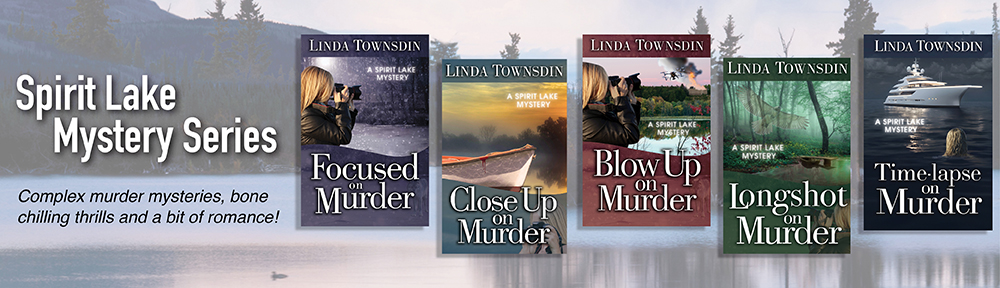
Focused on Murder –A Spirit Lake Mystery

Where did the idea come from for the book?

I wanted to write about Northern Minnesota, where I spent much of my childhood. So far, I have three Spirit Lake Mysteries in different stages of development. Focused on Murder is completed, Close up on Murder is being revised, and I’m nearly finished with a second draft of Exposed.

What genre does your book fall under?

Traditional mystery/thriller

Which actors would you choose to play your characters in a movie rendition?

When I read, I prefer to visualize the characters in books without too much detail from the author, but Claire Danes’ character from Homeland comes to mind for Britt, only taller and physically very fit. Adam Beach would be great as forest ranger, Ben Winters.

What is the one-sentence synopsis of your book?

When photojournalist Britt Johansson stumbles across the frozen body of a co-ed in the wilds near the US/Canadian border, it sets her off on a hunt for the killer, putting her into the crosshairs of an international crime ring investigation.

Will your book be self-published or represented by an agency?

I’m ready to make this happen, and I’m open to all possibilities.

How long did it take you to write the first draft of your manuscript?

The first draft took about a year. The second draft has taken another year because I stopped to write a first draft of Exposed during NaNoWriMo.

What other books would you compare this story to within your genre?

I like Steve Hamilton, John Sandford, William Kent Krueger, Louise Penny, Denise Hamilton, Kate Atkinson and Jim Lynch. Jim Lynch isn’t in my genre, but his characters and settings are wonderful.

Who or what inspired you to write this book?

I love Northern Minnesota and wanted to pay homage to the Native American culture of that area, the weather, lakes, small towns and people. It’s my way of keeping in touch with my roots.

What else about your book might pique the reader’s interest?

Photojournalist Britt Johansson will push the limits to keep the bullies of this world from winning. Ben is a forest ranger dedicated to protecting the national forests and all the creatures in it. Too often, that means keeping the two-legged creatures from using the forests for their dirty deeds.

My books are also about family and community—not always pretty. I’ve chosen a small-town setting because it’s a microcosm, but shameful secrets and selfless actions happen among humans everywhere, city, suburb, or slum. Even though my mysteries are about the horrible things people can do to each other, they’re also about the everyday heroes who tip the balance and enhance our lives—the people who pay attention to us, see our flaws and love us anyway.

I hope you’ll check out the excellent authors I’ve tagged, members of Sisters in Crime and my mystery critique group.

http://junegillam.com/blog/

http://www.micheledrier.com/

High Concept vs. Heart

It’s the first day of spring and almost Easter, flowers are blooming and leaves are sprouting on bushes. Lots of resurrection going on.

And yet I’m acutely aware that we experience a pretty big chunk of loss in a lifetime and it can happen in any season. The older you get, the more loss you experience. Loved ones die, and there are the other losses; the loss of a job, an opportunity, or maybe even a dream.

In my case, an adored child moved far away. My sadness is tempered with pride and joy as she embarks on an exciting new venture.

Time to Regroup

I set out to find relief and that’s always been through writing. However, at the moment I’ve been concentrating on getting what I’ve written published. I’ve sent my manuscript to agents, but learned that the way to attract an agent is to write a high-concept novel that starts with a bang. My goal was never about tricking an agent into looking at my novel.

I wanted to engage a reader’s heart.

I finally made up my mind the best way to do that was to cut out the middleman and go directly to the source. Now I’m working with a cover artist and will soon self-publish.

Ah, resurrection.

Oh, and I’ve already booked a flight to visit my daughter.

photo

The Universe is Speaking

I’ve learned to pay attention when the universe knocks on my door. Admittedly, in the past, I have let multiple hints slip right by me until something drastic comes along to jolt me out of my fog.

This time the messages started with a notebook from the bins inside Target’s front entrance. I picked up one with Yoda on the front.  A conversation bubble above his head said, “Do. Or do not. There is no try.”

I put it in my cart.

Yesterday I attended a cold wax workshop by Sara Post, a wonderful encaustic artist from Davis, CA. In addition to a demonstration on technique, she offered this advice: “If you’re going to do it, do it very.” Artists are always concerned about pushing too far and ruining a piece. I loved this advice.

This morning at my women’s Kaia workout, the message on the board said, “Committing to 99% is brutal; 100% is easier.”  If you think 99% is a good enough goal for workout, nutrition, intentions, etc., then you’ve opened the door to eroding away your resolve. That makes it harder.  I hadn’t thought of it that way before.

I subscribe to Seth Godin’s blog. Today his advice was that showing up isn’t enough.  To paraphrase: “Your job is to surprise and delight and change the agenda, escalate, and reset expectations.”

How do all these signs relate to my writing?

My mystery novel is finished. It’s been revised, reviewed and polished. Of course, I could work on it forever, but that doesn’t get it out the door. I’ve been researching agents and sending out queries, but I’m still on the fence about whether self-publishing is a better way to go.

I think the universe is saying:  Do it very. Give 100% and you will surprise and delight yourself.

Do you listen when the universe speaks to you?

imagesCA45J0AK

Overcoming Resistance on Your Writing Journey

I bought the book, The War of Art, Break Through the Blocks and Win Your Inner Creative Battles, by Steven Pressfield for a young artist/musician and seeker. I skimmed it and thought the references to war and battle would be attractive to a male. And he loved it. He even read parts of it to me that he thought I’d like. And I did, so I bought a copy for myself and read the entire book in one sitting. I’ve read a number of books about writing motivation, so some of it was familiar, but every time I read something like this, or re-read, it reaches a new place in me that needed to hear it. There were many such places in this book.

The book is written in three sections: Part One, Defining the Enemy; Book Two, Turning Pro; and Book Three, The Higher Realm. Here are a few gems on resistance:

“Resistance is most powerful at the finish line.” It’s true. Right now, I have a finished draft of my mystery, Focused on Murder, and have sent it out to exactly one agent. This section turned a light on my resistance. I fooled myself into thinking there weren’t enough hours in the day to research agents and send out queries and synopses when I wanted to take on the 50,000 words in one month NaNoWriMo challenge. I’ve done great with that and have a first draft of a brand new novel, but my finished novel sits.

Resistance and Procrastination. “Procrastination is the most common manifestation of resistance because it’s the easiest to rationalize. We don’t tell ourselves I’m never going to write my symphony. Instead, we say, I’m going to write my symphony, I’m just going to start tomorrow.”

Resistance and Unhappiness. “As artists and professionals it is our obligation to enact our own internal revolution, a private, insurrection within our skulls.”

Resistance and Healing. “Remember, the part of us that we imagine needs healing is not the part we create from; that part is far deeper and stronger.” The part we create from can’t be touched by anything our parents did, or society did. That part is unsullied, uncorrupted; soundproof, waterproof, and bulletproof. In fact, the more troubles we’ve got, the better and richer that part becomes. The part that needs healing is our personal life. Personal life has nothing to do with work. Besides, what better way of healing than to find our center of self-sovereignty? Isn’t that the whole point of healing?”

I hope you, too, find something in these words that helps you in your writing journey.