Wise Words on Writing

Wise Words on Writing

Journal writing has always been my friend, my therapist, and my safe place to unburden.  I recently read a piece by the wonderful poet, Sharon Olds  that talked about writing through pain. The full article was about how she handled her divorce, but even if you’re not going through a divorce, Olds’ advice can help with the loss and heartache we all experience throughout our lives. Here are a few of her words of wisdom.

Sharon Olds

“Writing or making anything—a poem, a bird feeder, a chocolate cake—has self-respect in it. You’re working. You’re trying. You’re not lying down on the ground, having given up. And one thing I love about writing is that we can speak to the absent, the dead, the estranged and the longed for—all the people we’re separated from. We can see them again, understand them more, even say goodbye.”


sometimes you just need to fill the well

Pescadero State Beach, CA

Letting Your Story Go

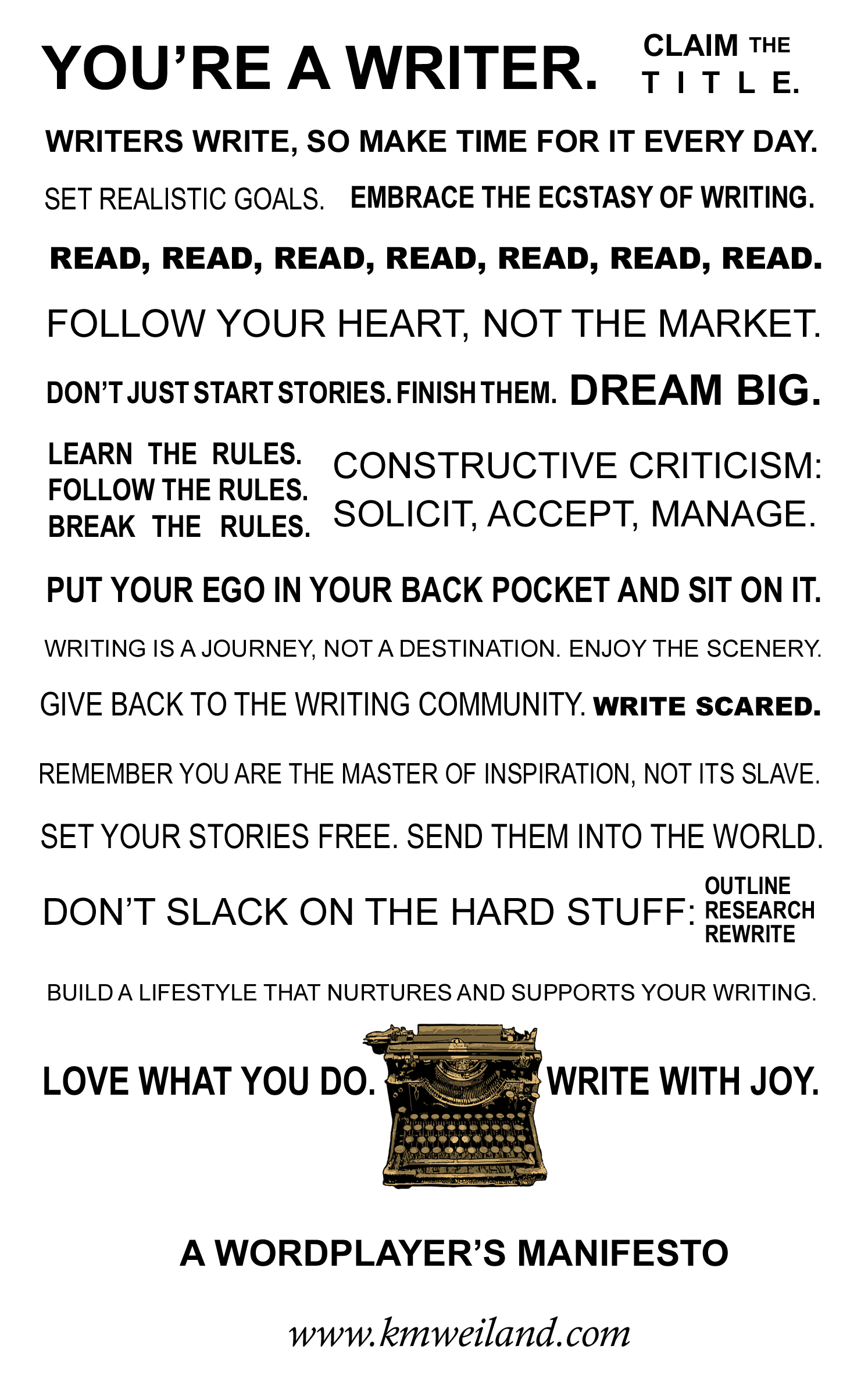
I’m close to finishing the second draft of my mystery, Focused on Murder. I’ve rearranged chapters for maximum suspense, ramped up my subplot with new scenes and once I’ve reviewed and edited it, I’ll have carried out the most important step in K.M. Weiland’s “Wordplayer’s Manifesto” I posted a couple of weeks ago: Don’t just start stories, finish them.

Next on the Wordplayer’s list: Set your stories free. Send them into the world.

The time is getting close for me to let it go, but I’m torn between wanting to let it fly and continuing to tinker. Will it be as good as I can get it? Probably never. But where exactly is that place where you know it’s ready?

Paying attention to my inner voice

I used to paint large canvases and mixed media pieces and I recall standing at the same precipice. Is it ready to show? Will a few more brushstrokes enhance or ruin it? After not listening to my inner voice and adding one more touch and then another I ruined my share of paintings until I eventually learned to pay closer attention.

I know I’ve ruined a few short stories and one early attempt at a mystery as well by adding one touch too many. I don’t want that to happen this time.

In my blog from July 3, Inspiration Comes in Three’s, I quoted Kristine Kathryn Rusch: “The book will never be perfect. Take the advice that those of us who’ve worked in broadcasting learned long ago. I think it was best expressed by Tina Fey in Bossy Pants: The show doesn’t go on when it’s finished; it goes on because it’s 11:30. Exactly. At some point, you must simply let go of that book or story or play and move to the next.”

Reading Rusch’s piece again reminded me not to take myself so seriously. I’m writing a mystery that I hope will entertain, with characters who have enough emotional depth and honesty so readers will want to continue reading stories about them. I’d also like to leave readers with my take on turning a few stereotypes upside down.  

What do you do to trust your inner voice and not let the negative noise get in the way?

Rescued by Pen and Paper

Welter. A confused mass; a jumble; a state of turmoil, confusion, or a disorderly or chaotic situation.

Last week my writing life went awry. A short vacation, out of town guests, and other interruptions had kept me from working on my mystery novel revision, and I was worried that if I left it too long I’d be lost and have to start at the beginning again. Several other writing and editing projects were pending as well.

I opened my laptop. But my laptop did the unthinkable. It dumped data, blue-screened and made scary demands. I did everything it commanded but that wasn’t enough. I hit Safe Mode but I was too late. My laptop froze.

I bundled it up and raced to have it repaired. The kindly technician reassured me he would run diagnostics and call me as soon as he found out anything. I reluctantly left it behind feeling unbalanced and confused, all jumbled up.

Goldilocks and the three computers

Back home, I pulled out my old Dell laptop and booted it up, but it was slow and much too small for me.

I sat at my husband’s 22-inch giant screen computer and attempted to work on my projects but it was too big and cumbersome.

Only my laptop was just right. And it was not there.

Enantiodromia. The changing of something into its opposite. A principle introduced by Carl Jung that the superabundance of any force inevitably produces its opposite. It is equivalent to the principle of equilibrium in the natural world, in that any extreme is opposed by the system in order to restore balance.

Could this be an opportunity for me to do a diagnostic on myself? I’d set up goals and deadlines to finish my book but wasn’t making as much progress as I projected. My inner landscape was a welter of imagined obstacles.  I was forcing what couldn’t be forced. I’d put too much importance on the result and forgot to enjoy the process. I even forgot I could pick up a pen and paper, which is exactly what I did. And happily wrote for four solid hours.

Many thanks to Laura Martin and Jan Haag in my writing group for a couple of writing prompts that jump-started today’s blog for me. My laptop is healthy again. Dirt in the fan caused overheating and a few corrupted files were fixed. It wasn’t the huge catastrophe I imagined after all. All is well. Balance restored.

Wordplayer’s Manifesto

Inspiration from all kinds of sources keeps me focused and this week a friend introduced me to to K.M. Weiland’s blog,  Helping Writers Become Authors.

Weiland created the Wordplayer’s Manifesto with her blessings to pass it along on blogs, add it to our desktops or print it out. I’ve done all of those things.  I hope it inspires you as well.